Governance

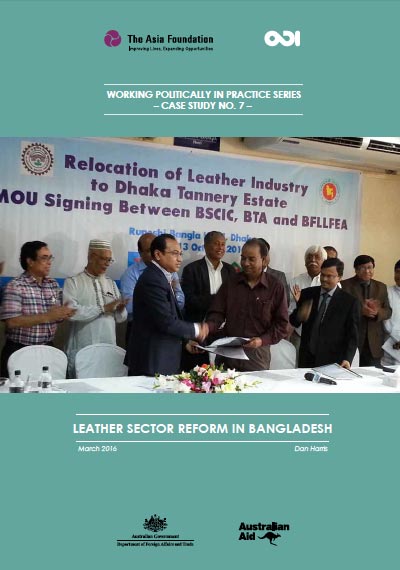
Leather Sector Reform in Bangladesh

This paper examines the Asia Foundation’s efforts to support change in Bangladesh’s leather sector. Working closely with local partners, the Asia Foundation team has specifically supported efforts to move tanneries…

Aid and Recovery in Post-Earthquake Nepal (Phase 1)

On 25 April 2015, a powerful 7.8-magnitude earthquake struck Nepal. Thousands were killed, tens of thousands were injured, and hundreds of thousands of homes were damaged or destroyed. A second major earthquake struck less than three weeks later, killing hundreds more and adding to the destruction. National and international aid providers quickly responded with emergency aid. But developing effective plans for long-term sustainable recovery requires knowledge of the needs of the affected, how they evolve over time, and the effectiveness of aid in addressing these needs.

The Independent Impacts and Recovery Monitoring Nepal (IRM) project contributes to this by assessing longitudinally five issues—aid delivery and effectiveness; politics and leadership; social relations and conflict; protection and vulnerability; and economy and livelihoods, through two research components: quantitative survey and qualitative field research. In order to track changes over time, multiple rounds of work are planned. The first round of research was complete during June 2015. Detailed findings can be found in three newly-released reports outlining findings from: (i) the quantitative survey; (ii) qualitative field monitoring and (iii) a synthesis of the qualitative and quantitative work.

Part of Independent Impacts and Recovery Monitoring Nepal Phase 1 collection.

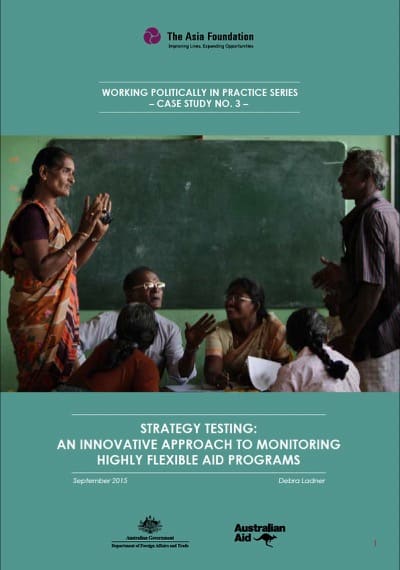
Strategy Testing: An Innovative Approach to Monitoring Highly Flexible Aid Programs

The international development community has increasingly embraced the idea that finding durable solutions to complex development problems requires new ways of working that move beyond industry norms. This paper makes an important contribution to the current debate by outlining an innovative monitoring system called strategy testing. This is the third paper in the Working Politically in Practice paper series, launched together with the Australian Department of Foreign Affairs and Trade.

Migrant and Child Labor in Thailand’s Shrimp and Other Seafood Supply Chains: Labor Conditions and the Decision to Study or Work

To address child labor and labor conditions of migrant workers in Thailand's shrimp and other seafood supply chains, the International Labour Organization and The Asia Foundation present the landmark study: Migrant and Child Labor in Thailand's Shrimp and Other Seafood Supply Chains: Labor Conditions and the Decision to Study or Work. The study provides practical, empirically grounded policy recommendations to stakeholders in both national and provincial governments and industry, drawing on a combination of existing evidence and data from the ILO's work in Thailand and supplementary qualitative information generated through informant interviews, focus group discussions, and consultations with stakeholders.

Read the news release here.

Rido: Clan Feuding and Conflict Management in Mindanao

The new 2014 Rido: Clan Feuding and Conflict Management in Mindanao – Expanded Edition is edited by Wilfredo M. Torres III and published by The Asia Foundation and the Ateneo de Manila University Press. An expanded edition of the 2007 edition, this is a comprehensive and informative resource on rido and features deeper analysis and new approaches to resolving local clan conflict, still prevalent in many parts of Muslim Mindanao.

The book is available for order at the Ateneo University Press website. Read more about the book launch here.

The Contested Corners of Asia: Subnational Conflict and International Development Assistance

Subnational conflict is the most widespread, enduring, and deadly form of conflict in Asia. Over the past 20 years (1992-2012), there have been 26 subnational conflicts in South and Southeast Asia, affecting half of the countries in this region. This study was conducted to help improve how development agencies address subnational conflicts.

Skip Footer