
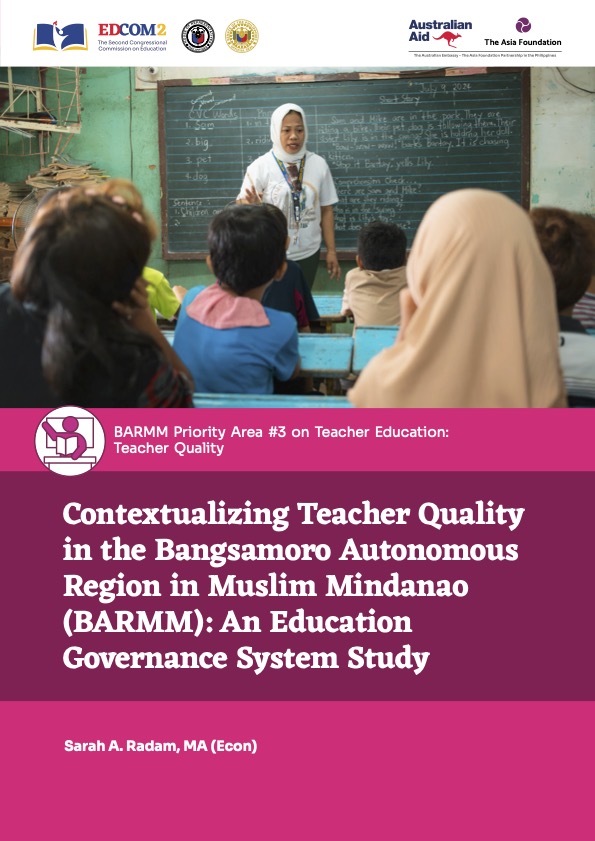
Contextualizing Teacher Quality in the Bangsamoro Autonomous Region in Muslim Mindanao (BARMM): An Education Governance System Study
By Sarah A. Radam, MA (Econ)
Series Summary: The Philippines’ education system is at a crossroads. Despite decades of reform, millions of children still cannot read, write, or perform basic mathematics – symptoms of systemic failures that threaten the nation’s future. The broader four-study series, supported by The Asia Foundation, EDCOM II, and the Australian Government, examines how governance, teacher development, and early childhood systems can work together to strengthen the foundations of learning. Together, the studies outline a roadmap for transforming Philippine education, with particular attention to Bangsamoro Autonomous Region in Muslim Mindanao (BARMM), where cultural and post-conflict realities require context-sensitive approaches.
The study highlights that improving teacher quality in BARMM is central to building a responsive, equitable, and resilient education system; one capable of supporting over a million learners and tens of thousands of educators. It calls for a shift from fragmented, short-term efforts to sustained, systems-level reforms that enable teachers to teach effectively and support foundational learning. Achieving this requires consistent investment, clear governance structures, and policies that value both technical quality and cultural relevance. To address current gaps – including the lack of harmonized policies and a coordinated roadmap for teacher education – the study outlines five strategic pillars that will enable this system to succeed: better regulatory structures, improved workforce planning, enhanced teacher preparation, stronger infrastructure, and continuous professional development.
Download the reports in the series: