Strengthening the Foundations of Education: New Research Calls for Systems Reform in the Philippines
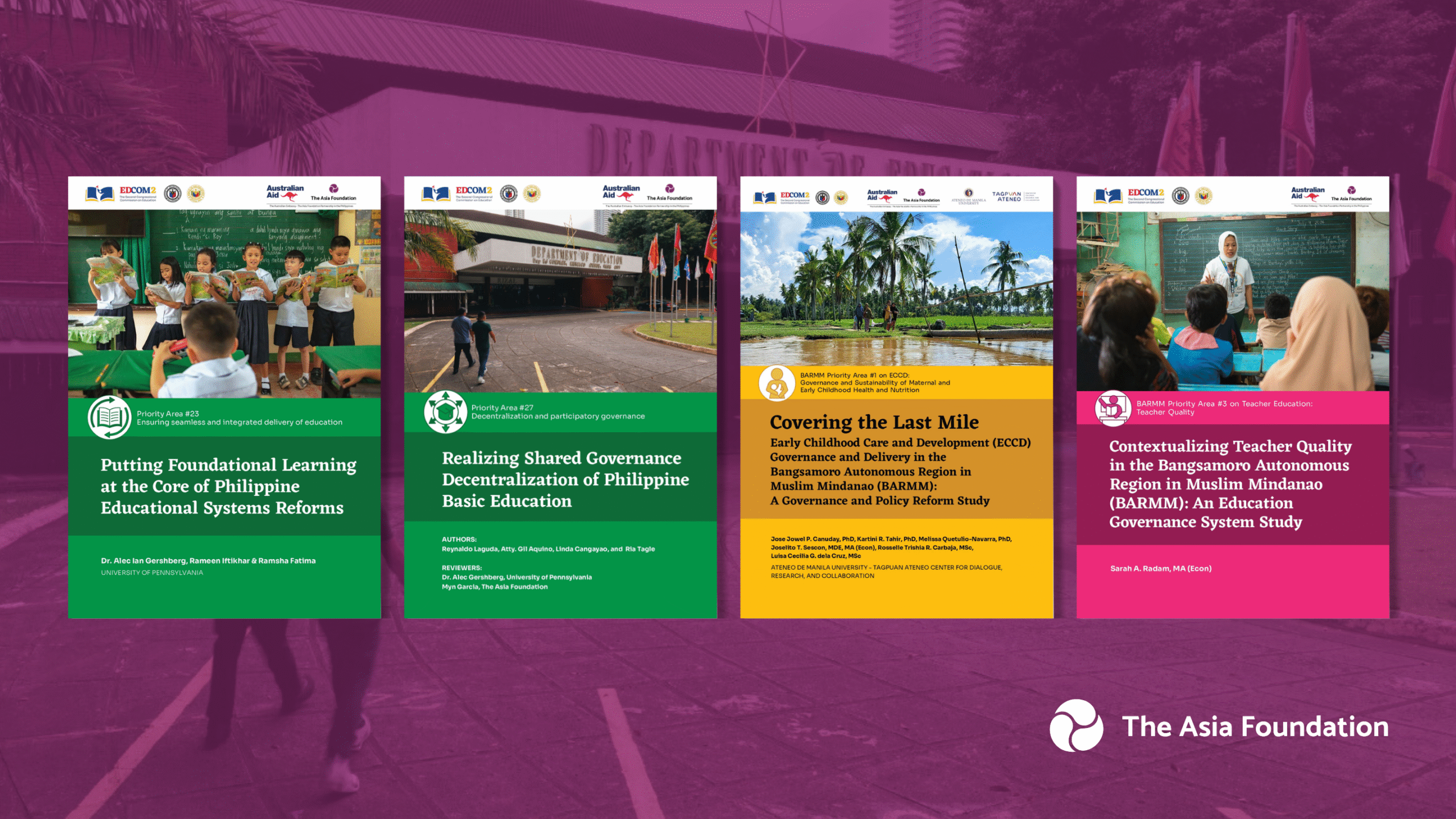
MANILA, Philippines, November 13, 2025 – The Asia Foundation, in partnership with the Second Congressional Commission on Education (EDCOM II) and the Australian Government, conducted four research studies to examine the roots of the Philippines’ learning crisis and chart a path toward systemic education reform in the country and in the Bangsamoro Autonomous Region in Muslim Mindanao (BARMM).
The Philippines faces a severe learning crisis, as evidenced by national and international assessments that reveal significant deficiencies in reading and numeracy among children. The consequences ripple through their entire educational journey and beyond. This research collaboration with EDCOM II looks beyond symptoms of this crisis and presents evidence-based, actionable recommendations for reform. This calls for a paradigm shift: from fragmented, reactive measures to sustained, systems-level change.
Back to Basics
At the heart of the research series is a clear message: to improve learning outcomes, education reform must begin with the basics. This means focusing on the foundations: early childhood education, nutrition support in the first 1,000 days of life, literacy by the end of Grade 3, with stronger governance, coordinated systems, and robust support for teaching.
The research also emphasizes that piecemeal reforms won’t work: foundational learning and governance reform must go hand in hand. “If we fail to establish these cornerstones, the rest of the structure cannot stand,” notes EDCOM II’s Fixing the Foundations Year Two Report.
From Research to Action
The studies represent more than academic analysis—taken together, the research provides critical evidence to inform the national reform agenda. “The foundation determines everything that follows,” the research team emphasized. “Get this right, and the Philippines can transform learning outcomes for generations to come.”
The Second Congressional Commission on Education (EDCOM II), established under Republic Act No. 11899, is a national body tasked with assessing and reforming the education sector from 2023 to 2025. These studies provide the evidence base for that critical work.
In BARMM, this agenda carries added significance: education is not only a social investment, but a peacebuilding imperative. Strengthening early learning systems supports the region’s long-term stability and self-determination. “Fixing this ecosystem—aligning policies, financing, workforce capacity, and community engagement—is not simply a technical requirement, but a peacebuilding imperative,” the Early Childhood Care and Development (ECCD) Governance and Delivery in BARMM report concludes.
Four Interconnected Studies Linking Foundational Learning and Education Governance
1. Putting Foundational Learning at the Core of Philippine Education Systems Reforms
Foundational learning and core instructional support for ages 0-8 must become the centerpiece of education reform. The study identifies five priority actions: commit to universal learning, measure learning reliably, align systems around this goal, support teachers, and adapt based on results.
2. Realizing Shared Governance: Decentralization of Philippine Basic Education
Decentralization can be effective—if implemented correctly. The study examines how decentralization and shared governance can enhance the education system’s responsiveness to diverse learner needs. It emphasizes the importance of the Department of Education leading with a framework for decentralization, bolstering school-based management, enabling local decision-making in schools and local governments, enhancing capacities for redefined roles, and increasing school-level resources.
3. Covering the Last Mile: Early Childhood Care and Development (ECCD) Governance and Delivery in BARMM
Focusing on BARMM, this study highlights the vital link between education reform and the path to lasting peace, which requires a strong educational system with early childhood at its core. The study recommends three pillars for strengthening early childhood care and development: phased devolution of ECCD services, a whole-of-government ecosystem, and stronger local service delivery.
4. Contextualizing Teacher Quality in BARMM: An Education Governance System Study
Teachers are the backbone of learning and inclusion in BARMM, and to fix the foundations, this backbone must be supported. The goal is not to produce more teachers but to enable teachers to teach effectively so learners can learn. This study outlines five strategic pillars that will enable this system to succeed: better regulatory structures, improved workforce planning, enhanced teacher preparation, stronger infrastructure, and continuous professional development.
About the Partnership
The Asia Foundation’s support to EDCOM II reflects its long-standing commitment to evidence-based policymaking and inclusive governance across Asia and the Pacific. This research collaboration is supported by the Australian Government.
Access the reports:
Media Contact
Our development experts and staff in Asia, the Pacific, and the United States are available for media briefings and speaking engagements.
For assistance, please contact Strategic Communications:
Eelynn Sim, Director
[email protected]