Pacific Futures: Building Economies that Work for Everyone

Searching for a job can be daunting. It’s even more difficult if the job seeker has a disability and lives in a region that lacks infrastructure and technology to support people with disabilities.
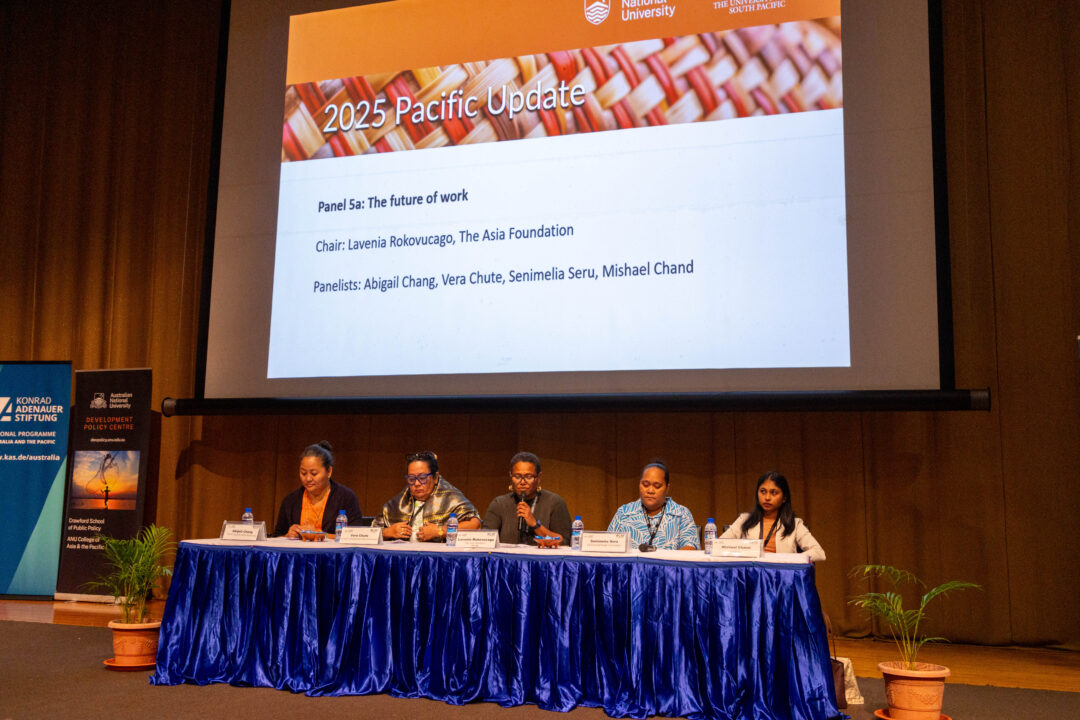
Senimelia Seru, office manager at the Fiji Disabled People’s Federation, emphasized that point while speaking on a panel chaired by The Asia Foundation (TAF) at the 2025 Pacific Updates conference held at the University of the South Pacific. She said of one jobseeker with a disability: “The young candidate with vision impairment excelled in the hiring process, only to be denied the job because the employer was unwilling to provide the necessary screen-reading software, citing the high cost of this accommodation as the final and insurmountable barrier.”
Seru said the solution is to design systems that work for everyone from the outset. Her point went far beyond disability. It captured the structural challenge shaping the Pacific’s future of work: unless institutions adapt, too many people will remain locked out of opportunity, while the region risks underutilizing its greatest resource, its own people.
A central tenet of The Asia Foundation’s work in the Pacific is supporting governments and organizations in adapting and expanding opportunities. The other side of that equation is providing educational and training opportunities for people to succeed in the future economy.
The panel, The Future of Work in Fiji: Building Adaptive and Digitally Ready Economies, brought together four Pacific women leaders: Abigail Chang, director of Pacific Australia Skills; Mishael Chand, digital transformation coordinator at Cadmus Pacific; Vera Chute, chair of the Women Entrepreneurs Business Council under the Fiji Commerce and Employers Federation; and Senimelia Seru. Their reflections revealed how communities are already navigating economic transition, and what choices now will determine whether Pacific economies thrive with the local labor force or continue to lose much of their workforce to opportunities abroad. Pacific economies will be shaped as much by the availability of secure livelihoods as by rising sea levels, extreme weather, and other environmental pressures.
Skills for Adaptability
Abigail Chang called for a shift away from narrow credentialing toward building adaptive capabilities. Certificates alone, she argued, leave young people chasing yesterday’s jobs.
“When you think about who you want repairing your car, you want someone who’s learned the skill, not just the theory,” she said. “That’s the kind of shift we need in how we view skills training in the Pacific: prioritizing applied capability over academic knowledge.”
Competency-based training, apprenticeships designed with employers, trainers embedded in industry, and modular micro-credentials are practical reforms that build resilience. From a political economy perspective, this is not just pedagogy but systemic reform that is realigning incentives in education and labor markets to reward adaptability, she said.
Connectivity as an Economic Divide
As in many parts of the world, bridging the urban-rural technology divide in the Pacific Islands needs to be a priority, Mishael Chand said. In just one example, she noted that if internet services are limited in rural areas, many students have to wait until they can get online to access their exam results, while their peers in Suva log in to see results instantly. As a young, aspiring leader dedicated to advancing digital development in the Pacific region, her point was clear: connectivity is no longer a convenience but a determinant of opportunity.
Her proposal, to build a network of community-based digital mentors, particularly women and youth who can pass on skills in local languages, illustrates how Pacific solutions can narrow digital divides. It highlights a deeper truth: digital divides are rarely just about infrastructure. They are the outcome of political and economic choices about affordability, reach, design, and whether systems are built to reflect the realities of Pacific lives.
TAF’s Google.org-funded Go Digital Pacific initiative, which provides training in digital technology and tools, reflects this same principle. Program data show that when women vendors learn to use smartphones for payments and promotion, it does more than digitize transactions, it strengthens households and markets. When systems are designed to work for everyone, digital transformation becomes an economic multiplier.
Women Entrepreneurs Driving Change
Vera Chute highlighted how women are diversifying Fiji’s economy through childcare services, eco-enterprises, and online businesses. While many women have received training and education to advance their businesses, there are still systemic obstacles: access to finance or finance that demands high collateral, trade policies that restrict access, and limited platforms to scale.
At the heart of Chute’s message was a reminder that women’s entrepreneurship is not peripheral but central to economic diversification. Yet ambition alone cannot deliver transformation without enabling policy environments. TAF’s collaboration with the Women Entrepreneurs Business Council on Fiji’ Green Policy underscores this potential: women entrepreneurs embedding sustainability into their businesses are already charting viable new pathways for Fiji’s economy.
It was not intentional that this panel featured four women leaders. Yet that fact signals something important: women are already at the forefront of building capabilities, driving digital innovation, growing enterprises, and demanding fairer systems. If policymakers want to unlock the region’s economic future, recognizing and scaling this leadership will be indispensable.
Designing Systems That Work
As Senimelia Seru pointed out, the challenge is not “adding inclusion” later but designing systems that work for everyone from the outset. People with disabilities are already innovating livelihoods in agriculture, hydroponics, and water security, but systemic barriers, which include unreliable transport, inaccessible infrastructure, and unaffordable assistive technology, undermine their agency in shaping their futures.
TAF’s partnership with the National Council for Persons with Disabilities, where people with disabilities audited Fiji’s land, sea, and air transport—reframed accessibility as an infrastructure and economic issue. When systems are designed with accessibility in mind, they expand opportunity for all.

Beyond Migration: Futures in the Pacific
A consistent thread ran through the panel: unless systems adapt, there will be less economic opportunity and greater pressure to migrate. While remittances provide vital support, they also reveal the costs of underdeveloped local economies. Everyday disruptions—disasters, shutting markets, outages halting businesses, and caregiving responsibilities limiting participation—show that the future of work is shaped not only by global opportunities but also by the design of systems within Pacific economies.
Toward a Pacific Reset
The Asia Foundation’s Pacific Islands regional mission is grounded in these insights: Pacific voices must shape futures through reforms that build adaptive capabilities, expand access, and enable thriving local economies.
The Pacific Update panel gave shape to what this vision looks like in practice:
- Education that cultivates adaptability, not just credentials.
- Policy environments that allow women entrepreneurs to thrive.
- Universal design and accessibility standards across infrastructure, transport, workplaces, and digital platforms.
- Digital systems that reach everyone.
- Institutions that embed fairness from the start.
- Economies that thrive locally, making mobility a choice, not a necessity.
Through initiatives like digital training supported by Google.org, early learning via Let’s Read, and applied research on care economies and accessibility, TAF is helping to seed the systemic reforms the region needs. These efforts are not ends in themselves but signals of a broader foresight approach, one that recognizes the Pacific’s economic future will be determined by choices made today, and insists those choices be grounded in genuine local partnerships, led by Pacific voices, and designed to expand agency, build resilience, and unlock the region’s full potential.
Media Contact
Our development experts and staff in Asia, the Pacific, and the United States are available for media briefings and speaking engagements.
For assistance, please contact Strategic Communications:
Eelynn Sim, Director
[email protected]